CeraVe vs Cetaphil Daily Facial Cleanser: Which Is Better for Sensitive Skin?

Disclosure: As an Amazon Associate I earn from qualifying purchases. If you click a link on this page and buy, HaqyaStore may earn a commission at no extra cost to you. Learn more.
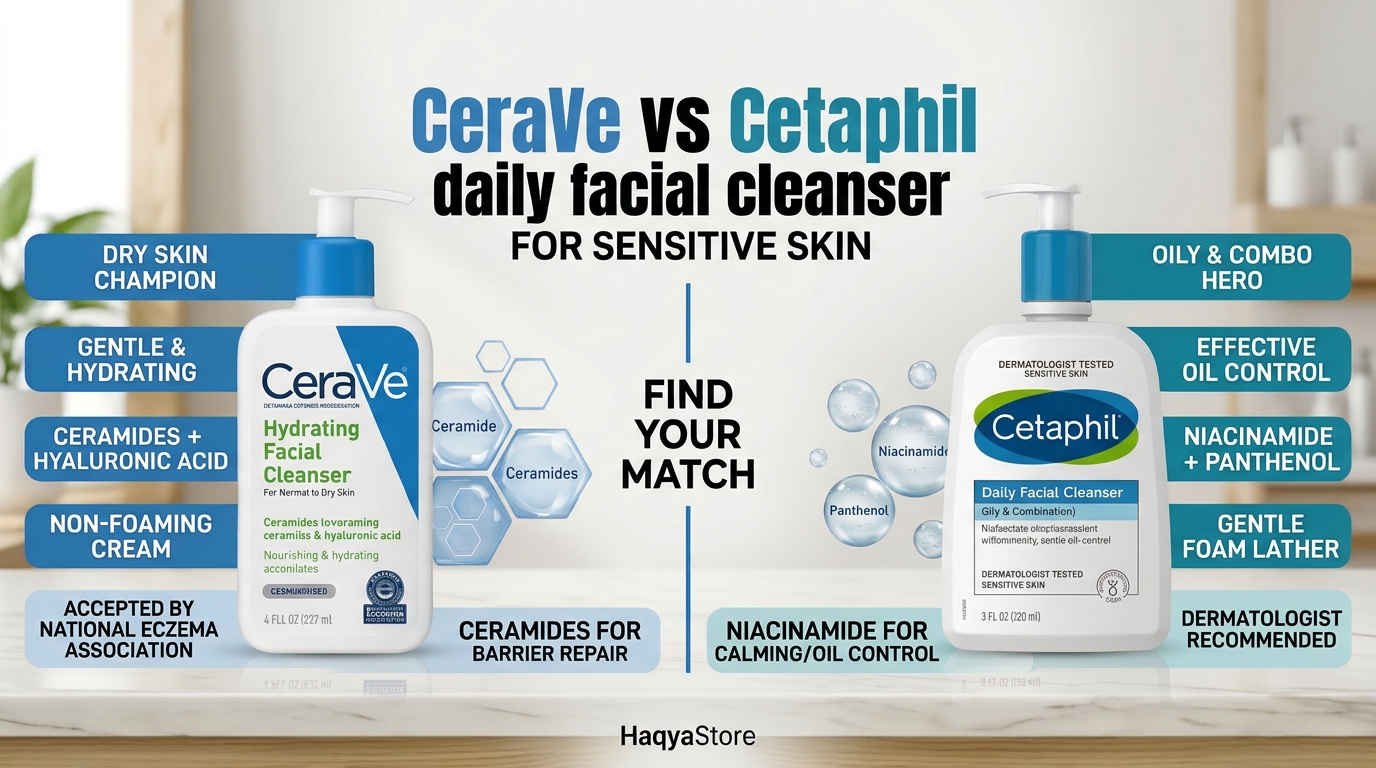
If you are weighing the CeraVe vs Cetaphil daily facial cleanser for sensitive skin, you have probably noticed that both are affordable, widely recommended and sold as gentle. The difference is in the details: one is a creamy, ceramide-based wash, the other is a gel-to-foam wash built around niacinamide. This guide explains which one suits which skin, so you can choose without comparing dozens of labels.
Honest note: we have not tested these products ourselves. This guide is based on the information on each brand’s product pages and listings. Claims such as “dermatologist tested” belong to the brands, not to us. Formulas and labels can change, so always read the label on the exact version you buy. See our How We Review page for our approach.
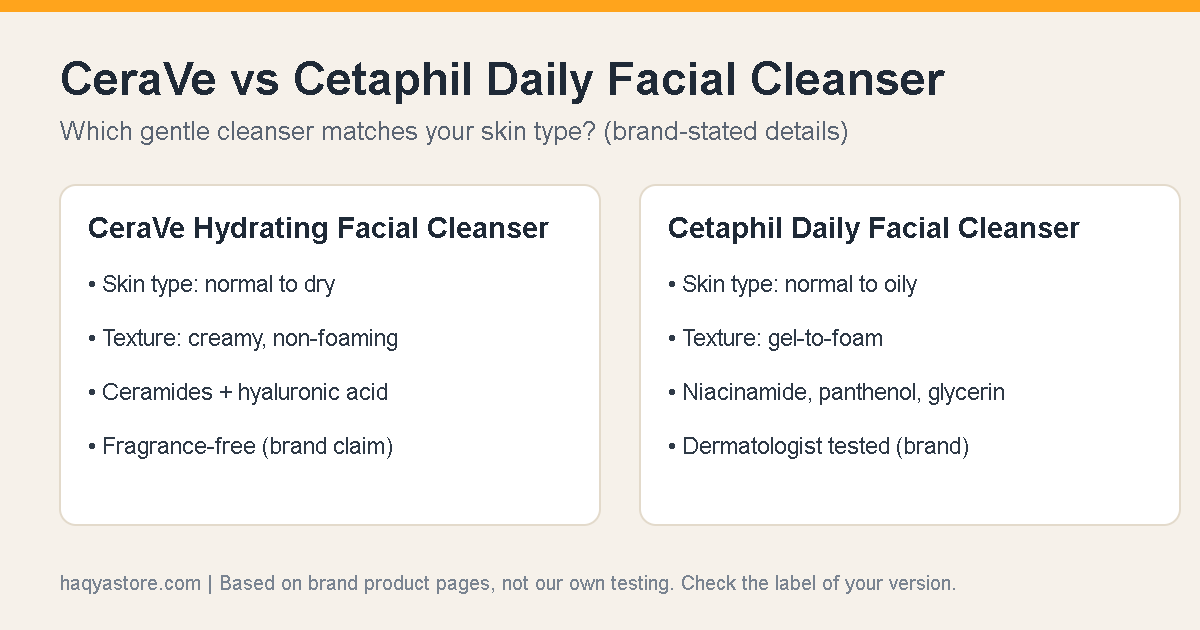
CeraVe vs Cetaphil Daily Facial Cleanser: The 20-Second Answer
- Dry or normal skin that feels tight after washing? CeraVe Hydrating Facial Cleanser is the more natural fit, because the brand makes it for normal to dry skin.
- Oily or combination skin that is also sensitive? Cetaphil Daily Facial Cleanser (Oily & Combination) is the one aimed at your skin type.
- Want a rich, non-foaming wash? Choose CeraVe. Prefer a light gel-to-foam lather? Choose Cetaphil.
- Important: these two are made for different skin types, so this is less a head-to-head winner and more a match-your-skin decision.
CeraVe vs Cetaphil Daily Facial Cleanser: Quick Comparison Table
| Feature | CeraVe Hydrating Facial Cleanser | Cetaphil Daily Facial Cleanser (Oily & Combination) |
|---|---|---|
| Texture (per brand) | Creamy, non-foaming wash | Gel-to-foam wash |
| Brand-stated skin type | Normal to dry | Normal to oily; also described for combination, sensitive skin |
| Key ingredients (per brand) | Three ceramides and hyaluronic acid | Niacinamide, panthenol and glycerin |
| Fragrance | Fragrance-free (brand claim) | Fragrance-free (brand claim). Check the label of your version |
| Sensitive-skin claims | Non-comedogenic; accepted by the National Eczema Association; developed with dermatologists | Dermatologist tested; hypoallergenic; non-comedogenic |
| Best for | Dry, tight-feeling or barrier-conscious skin | Oily or combination skin that still needs a gentle wash |
| Link | Check Price on Amazon | Check Price on Amazon |
Ceramides vs Niacinamide: What Is Actually Different?
The headline difference in the CeraVe vs Cetaphil daily facial cleanser debate is ceramides versus niacinamide, so it helps to know what each one is.
Ceramides (CeraVe)
Ceramides are lipids that occur naturally in the outer layer of skin. CeraVe builds its formula around three of them (ceramide NP, AP and EOP) together with hyaluronic acid, a humectant that attracts water. The idea is a cleanser that supports the skin barrier instead of stripping it.
Niacinamide (Cetaphil)
Niacinamide is a form of vitamin B3. Cetaphil pairs it with panthenol (vitamin B5) and glycerin in a gel-to-foam wash for normal to oily skin. The brand highlights gentleness and says it is dermatologist tested on sensitive skin.
A realistic caveat
A cleanser is on your skin for seconds before it is rinsed away, so do not expect the same effect you would get from a leave-on serum or moisturizer. The main job of either product is to clean gently without leaving skin tight or irritated. Ceramides and niacinamide are a nice bonus, not a treatment.
Moisture Barrier: Which One Is Gentler?
When comparing the CeraVe vs Cetaphil daily facial cleanser on barrier care, neither brand can promise your skin barrier will be protected, because every skin reacts differently. What we can compare is the design. CeraVe’s non-foaming cream texture and ceramide-plus-hyaluronic-acid formula are aimed at skin that loses moisture easily. Cetaphil’s gel-to-foam texture removes oil more noticeably, which is why it is positioned for oily and combination skin. If your skin often feels tight, flaky or stingy after cleansing, a creamy wash is usually the safer starting point. If you feel greasy by midday, a light foaming wash may feel better.
CeraVe vs Cetaphil Daily Facial Cleanser for Dry vs Combination Sensitive Skin
| Your skin | Start with | Why |
|---|---|---|
| Dry and sensitive | CeraVe Hydrating Facial Cleanser | Creamy, non-foaming and made for normal to dry skin |
| Combination and sensitive | Cetaphil Daily Facial Cleanser | Gel-to-foam wash made for normal to oily skin, with a gentle, fragrance-free positioning |
| Oily and sensitive | Cetaphil Daily Facial Cleanser | A lighter texture that suits oilier skin |
| Eczema-prone | Ask your dermatologist first | CeraVe is accepted by the National Eczema Association, but your doctor knows your skin |
CeraVe Hydrating Facial Cleanser: Pros and Cons
This is the creamy classic. According to CeraVe, it is fragrance-free, non-comedogenic, developed with dermatologists and accepted by the National Eczema Association. It is designed for normal to dry skin.
Pros
- Ceramides plus hyaluronic acid in a non-foaming cream
- Fragrance-free and non-comedogenic according to the brand
- Accepted by the National Eczema Association
- Simple to use morning and night
Cons
- Brand positions it for normal to dry skin, so oily skin may find it too rich
- No foam, which some people expect from a face wash
- Not designed to remove heavy waterproof makeup on its own
Cetaphil Daily Facial Cleanser (Oily & Combination): Pros and Cons
This version of the Cetaphil Daily Facial Cleanser is a gel-to-foam wash. The brand lists niacinamide, panthenol and glycerin, and describes it as dermatologist tested, hypoallergenic, paraben-free and non-comedogenic.
Pros
- Light gel-to-foam texture many people prefer for oilier skin
- Niacinamide, panthenol and glycerin in the formula
- Dermatologist tested and hypoallergenic according to the brand
- Made for the skin type that most cleansers ignore: oily but sensitive
Cons
- Aimed at oily and combination skin, so very dry skin may want something richer
- The brand’s own FAQ mentions that one version contains added fragrance, so check the label of the exact one you buy
- A foaming wash can feel stronger than a cream wash
CeraVe vs Cetaphil Daily Facial Cleanser: How to Choose
- Match the skin type first. This matters more than any single ingredient.
- Read the ingredient list of the exact version and size you are buying, especially if you avoid fragrance.
- Patch test a new cleanser on a small area for a few days before using it on your whole face.
- Wash gently with lukewarm water and pat dry. Hot water and scrubbing can irritate sensitive skin more than any cleanser.
- Stop using a product if your skin burns, itches or breaks out, and ask a dermatologist if it continues. The American Academy of Dermatology is a good place to learn more.
Frequently Asked Questions
Is CeraVe or Cetaphil better for sensitive skin?
Neither is better for everyone. CeraVe Hydrating Facial Cleanser is made for normal to dry skin, while this Cetaphil Daily Facial Cleanser is made for oily and combination skin. Both brands describe their cleansers as gentle, so choose by skin type.
Which has ceramides, CeraVe or Cetaphil?
CeraVe Hydrating Facial Cleanser lists three ceramides and hyaluronic acid. The Cetaphil Daily Facial Cleanser covered here lists niacinamide, panthenol and glycerin instead.
Are both cleansers fragrance-free?
Both brands describe these cleansers as fragrance-free. Cetaphil’s own FAQ mentions a version with added fragrance, so check the label on the exact bottle you are buying.
Can I use CeraVe in the morning and Cetaphil at night?
Some people alternate cleansers, but there is no need to. One gentle cleanser used consistently is usually enough. If you are unsure, ask a dermatologist.
Do I still need a moisturizer after a gentle cleanser?
A cleanser is not a replacement for a moisturizer. Many people with sensitive skin follow cleansing with a fragrance-free moisturizer.
Final Verdict: CeraVe vs Cetaphil Daily Facial Cleanser
The CeraVe vs Cetaphil daily facial cleanser question comes down to your skin type. Choose CeraVe Hydrating Facial Cleanser if your skin is dry or tight, and the Cetaphil Daily Facial Cleanser if your skin is oily or combination but easily irritated. Both are affordable, widely available ways to try a gentle routine, so treat either one as a low-risk trial.
Keep reading: see how CeraVe compares with a premium pharmacy brand in our CeraVe vs La Roche-Posay Toleriane comparison, or browse our best gentle cleansers for sensitive skin.
Last updated: November 8, 2026. Product details can change. This article is for general information and is not medical advice. If you have a skin condition, or your skin reacts to a product, speak to a dermatologist.